
Shoppers leave carts for normal reasons: they get distracted, compare prices, pause at shipping, or decide to “think about it.” Abandoned cart emails bring them back while the product is still fresh in their mind.
The best cart recovery emails aren’t pushy. They work like a short ecommerce email automation flow.
- Remind the shopper what they left behind.
- Reassure them with benefits, reviews, shipping, or returns.
- Offer urgency or a small incentive only when it makes sense.
Why Abandoned Cart Emails Work
Abandoned cart emails work because they reach shoppers while the product is still fresh in their mind and make returning easy.
Think of the email as a helpful shortcut back to checkout. Instead of asking someone to search your site again, you show the exact item they left behind, the price, the image, and a clear button back to their cart.
The best results usually come from an ecommerce email automation flow. An email automation is a prebuilt message that sends after a trigger, like someone adding a product to cart and leaving before buying. Timing matters, but the right timing varies by store, price point, and buying cycle.
These emails also work because they answer the shopper’s real hesitation. A first email can simply remind them. A second can reduce doubt with shipping, returns, reviews, or product benefits. A third can add urgency or a careful incentive if they still haven’t purchased.
Example 1: Simple Reminder
The first reminder has one job: help the shopper pick up where they left off. Don’t sell hard yet. Assume they got distracted, closed the tab, or wanted to check shipping later.
Use it as the opening email in your abandoned cart flow, typically a few hours after cart abandonment. That timing is only a starting point; expensive products or business-to-business purchases may need more breathing room.
Simple structure:
- Purpose: remind them of the exact item in their cart.
- Subject line angle: “Still thinking it over?” or “You left something behind.”
- Body: show the product name, image, price, and any key option like size or color.
- Call to action (CTA): “Return to cart” or “Finish checkout.”
- Avoid: discounts, guilt, countdown timers, or long paragraphs.
Before launch, test that the product block, cart button, and checkout link work on mobile.
Example 2: Benefit-focused Email
The second email should answer the shopper’s quiet question: “Why should I buy this from you?” Instead of jumping to a discount, use this message to reduce doubt.
Send it after the first reminder if they still haven’t checked out. A typical starting point is around 24 hours later, but adjust based on your product and buying cycle.
Simple structure:
- Purpose: remind them why the product is worth buying.
- Subject line angle: “A few reasons you’ll love this” or “Still deciding? Here’s what to know.”
- Body: highlight 2–3 benefits, such as comfort, durability, fit, ingredients, warranty, easy returns, or free shipping.
- Trust signals: add reviews, star ratings, press mentions, or “30-day returns.” Trust signals are proof points that make buying feel safer.
- CTA: “Return to your cart” or “Complete your order.”
For high-cart-value shoppers, lean harder on reassurance. For first-time visitors, explain your return policy clearly.
Example 3: Urgency or Incentive
Use the third email only for shoppers who still haven’t purchased after the reminder and reassurance emails. This is where urgency, meaning a real reason to act soon, or an incentive, like free shipping or 10% off, can help.
Simple structure:
- Purpose: give the shopper one clear reason to finish checkout now.
- Typical timing: often 24–72 hours after abandonment, but adjust for your product price, buying cycle, and market.
- Subject line angle: “Your cart expires soon,” “Last chance for free shipping,” or “Still want it? Here’s 10% off.”
- Body: show the cart items, state the deadline or offer clearly, and keep the message short.
- CTA: “Claim your offer” or “Complete checkout.”
Don’t discount every cart. For high-cart-value shoppers, try free shipping or concierge-style help. For returning customers, loyalty points may feel better than a coupon. Set coupon rules so the offer applies only to the intended segment and expires when promised.
Timing Recommendations
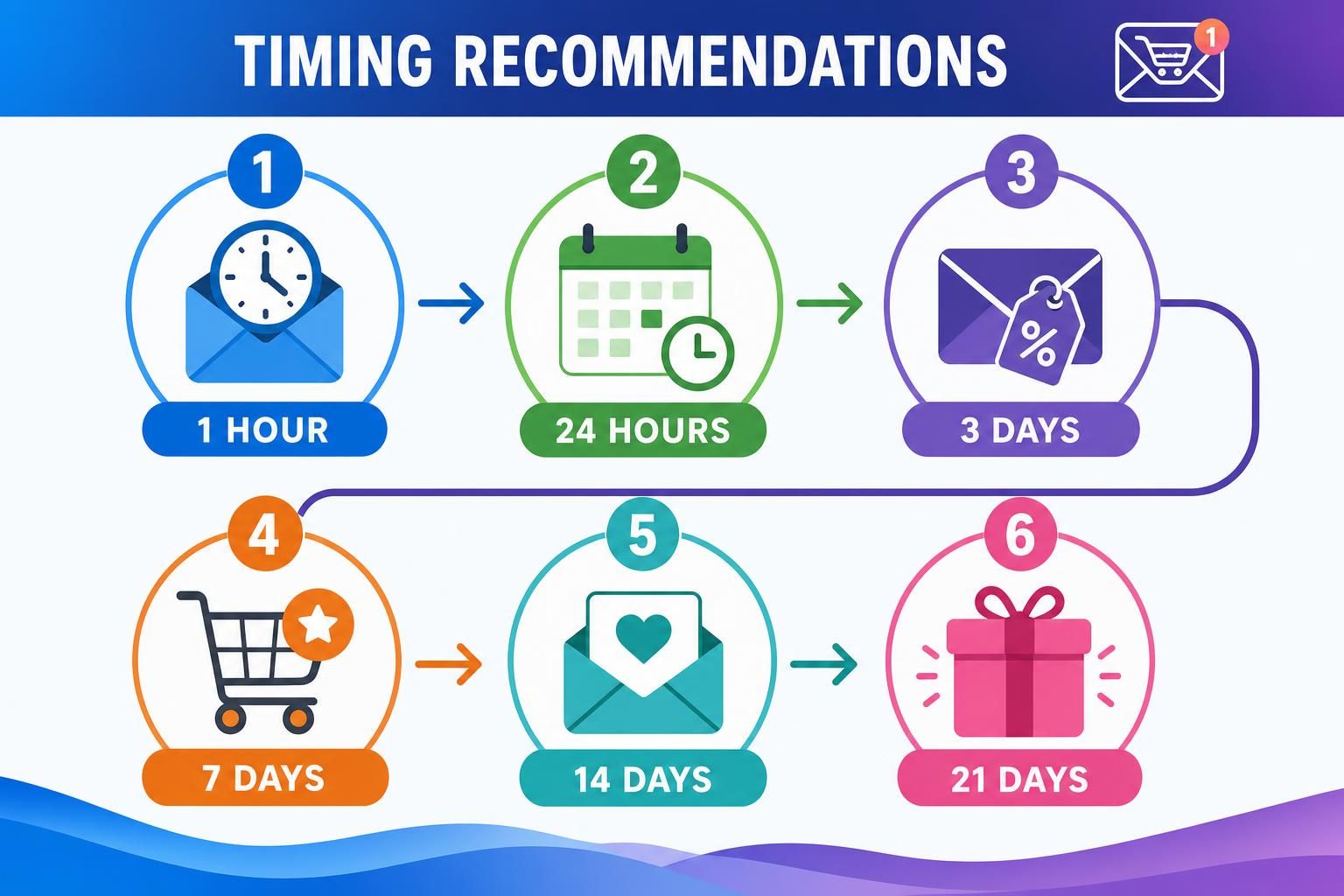
Treat timing as a starting point, not a rule. Your abandoned cart flow should match how long people usually take to decide in your store.
| Flow | Trigger | First delay | Email count | Main CTA | Suppression rule |
|---|---|---|---|---|---|
| Simple reminder | Cart abandoned | 1–3 hours | 1 | Return to cart | Stop after purchase |
| Benefit-focused | No purchase after email 1 | 18–24 hours | 1 | Complete order | Stop after purchase |
| Urgency or incentive | No purchase after email 2 | 48–72 hours | 1 | Claim offer | Stop after purchase or coupon use |
- Send email 1 after 1–3 hours. Use this for a simple reminder while the cart is still fresh. For low-cost products, sooner often makes sense. For expensive products, give shoppers a little breathing room.
- Send email 2 after 18–24 hours. Use this to answer doubts. Mention shipping, returns, reviews, product quality, or support. This is where first-time visitors may need more reassurance than returning customers.
- Send email 3 after 48–72 hours. Use urgency or a selective incentive only if they still haven’t bought. Segment this carefully. High-cart-value shoppers might get free shipping. Returning customers might get loyalty points. First-time shoppers may respond better to a small welcome discount.
Check your ecommerce email marketing tool, such as Klaviyo or Shopify Email, to make sure buyers exit the flow immediately after purchase.
What to Avoid
A good abandoned cart flow feels helpful, not desperate. Before you turn it on, check for these common mistakes.
- Sending too many emails or ignoring consent. Three is a sensible starting point for many stores, but use opt-in consent where required, honor unsubscribes, avoid mixing promotional content into transactional-only emails, and monitor spam complaints.
- Using fake urgency. Don’t say “almost gone” unless stock is actually limited.
- Making the CTA unclear. CTA means call to action, the button you want someone to click. Use one direct button like “Return to cart” or “Complete checkout.”
- Discounting too early. If every first email has 15% off, shoppers may learn to abandon carts on purpose.
- Ignoring mobile design. Most shoppers will read on a phone, so test buttons, product images, and checkout links on a small screen.
- Sending the same message to everyone. A returning customer doesn’t need the same reassurance as a first-time visitor.
Review timing, segments, and testing before launch so the flow feels consistent from email to checkout.
Metrics to Track

Track the whole flow, not just each single email. An abandoned cart email can have a great subject line and still fail if shoppers click back to a confusing checkout page.
| Metric | What it tells you | Use it to decide |
|---|---|---|
| Open rate | How many recipients opened the email | Test subject lines and sender name |
| Click rate | How many clicked the cart button or product link | Improve CTA wording, layout, and product block |
| Placed-order rate + revenue recovered | How many bought and how much sales came back | Compare reminder, benefit, and incentive emails |
| Unsubscribe rate + checkout behavior | Who opts out and where shoppers drop off | Reduce pressure, fix checkout friction |
- Treat open rate as directional. Privacy changes can inflate or obscure opens, so use it mainly for subject-line clues and rely more on clicks, revenue, conversions, unsubscribe rate, and placed-order rate.
- Check click rate next. If people open but don't click, the email may be too wordy or the call to action isn't obvious.
- Check conversion rate after clicks. If clicks are strong but purchases are weak, the problem may be shipping cost, payment options, or checkout speed.
- Watch unsubscribes. A spike after the third email usually means the urgency, discount, or frequency feels too aggressive.
FAQ
How Many Abandoned Cart Emails Should I Send?
Start with three emails: a reminder, a reassurance email, and a final urgency or incentive email. That’s usually enough to help without crowding the shopper. If unsubscribes rise or clicks drop sharply on the third email, trim the flow or soften the message.
Should Every Abandoned Cart Email Include a Discount?
No. Use discounts carefully. A first-time visitor with a low-value cart may need reassurance more than a coupon. A high-cart-value shopper may respond better to free shipping, payment options, or return details. Save discounts for shoppers who don’t come back after the first reminder.
What’s the Best Subject Line for an Abandoned Cart Email?
The best subject line matches the email’s purpose. For reminders, try “You left something behind.” For benefit-focused emails, try “Still thinking it over?” For incentives, try “Your cart offer ends soon.” Keep it clear, short, and honest. Don’t fake urgency just to get an open.
Can I Set This up in an Email Automation Tool?
Yes. Tools like Klaviyo, Mailchimp, Omnisend, and Shopify Email can trigger messages when someone leaves checkout without buying. You’ll connect your store, choose timing, add product blocks, and set basic segments. If you’d rather have it built for you, our Email Marketing service can help create the full flow.
Conclusion
A strong abandoned cart flow isn’t just one “come back” email. It’s a short sequence that changes the reason to return: first a reminder, then reassurance, then a careful incentive if needed.
Use these abandoned cart email examples as a starting point, then adjust by timing, cart value, customer type, and product. Keep the message helpful, make the cart link obvious, and watch your metrics after launch. Your next step is to draft the three emails, set them live in your email tool, and review the results after enough shoppers have moved through the flow.