
Campaign emails are one-off sends. Ecommerce email marketing flows are automatic emails triggered by shopper behavior, like signing up, leaving a cart, browsing a product, buying, or going quiet.
Start with five flows: welcome, abandoned cart, browse-abandonment, post-purchase, and win-back. Together, they guide shoppers from first interest to repeat purchase without you manually sending every message.
Build them in this order:
- Capture new subscribers.
- Recover high-intent carts.
- Follow up on product browsing.
- Support new customers after purchase.
- Reactivate past buyers.
Why Email Flows Matter for Ecommerce
Email flows matter because they respond to shopper behavior automatically. A flow is a pre-built email sequence that sends when someone takes a specific action, like joining your list, viewing a product, adding to cart, buying, or going quiet.
Use this setup map as a starting point; adjust delays for price, replenishment cycle, and consideration time.
| Flow | Trigger | First delay | Email count | Main CTA | Suppression rule |
|---|---|---|---|---|---|
| Welcome | Signup | Immediate | 2–3 | Claim offer/shop bestsellers | Purchased or unsubscribed |
| Abandoned cart | Cart/checkout left | 1–3 hours | 2–3 | Return to cart | Purchased/support/checkout flow |
| Browse abandonment | Product viewed | 2–4 hours | 1–2 | View product | Carted or purchased |
| Post-purchase | Order placed | Immediate | 3–4 | Use product/review/next item | Canceled/refunded/wrong SKU |
| Win-back | Inactive period | At threshold | 2–3 | Restock/shop new | Recent buyer/cart/unsubscribed |
Subject-line angles can mirror intent: welcome code, still interested, order help, or ready to restock. Use opt-in consent, honor unsubscribes, avoid promo content in transactional-only emails, and monitor spam complaints.
For ecommerce brands, that means you’re not waiting until the next newsletter to follow up. You’re meeting the shopper at the right moment in their buying journey.
Think of flows like helpful store staff. One person greets new visitors. Another reminds someone they left items at checkout. Another checks in after purchase and explains how to use the product. Each message has a job.
They also support owned revenue, which means sales from channels you control, like email and SMS, instead of relying only on ads or social platforms. Done well, flows improve customer experience while protecting sales you might otherwise lose.
Welcome Flow
A welcome flow turns a new subscriber into a first-time buyer while their interest is fresh. If someone enters their email for a discount, product updates, or a back-in-stock alert, send the first email immediately.
- Trigger: New email signup from a popup, footer form, or quiz.
- Exclusions: Remove people once they buy. Don’t send to unsubscribed contacts.
- Email count: Start with 2–3 emails.
- Timing: Email 1 immediately, Email 2 after 1 day, Email 3 after 2–3 more days.
- Message angle: Deliver the promised offer, introduce your bestsellers, explain what makes your products different, and answer one common buying question.
- Primary metric: First-purchase conversion rate.
Don’t make every email a discount reminder. Think of this flow like a friendly first store visit: greet them, guide them, then give them a clear next step.
Abandoned Cart Flow
An abandoned cart flow helps recover shoppers who added products to their cart but left before paying. The intent is high. They’ve already shown buying interest, so your job is to remove doubt and make returning easy.
- Trigger: Someone adds an item to cart or starts checkout but doesn’t complete the order.
- Audience exclusions: Remove anyone who purchases, has an active support issue, or is already in a checkout recovery flow.
- Email count: Start with 2–3 emails.
- Timing: Email 1 after 1–3 hours, Email 2 after 24 hours, Email 3 after 2–3 days if needed.
- Message angle: Show the abandoned product, answer common objections, mention shipping or returns, and include one clear button back to cart.
- Primary metric: Cart recovery conversion rate.
Don’t lead with a discount every time. Try reassurance first, then use an incentive only when it protects margin.
Browse Abandonment Flow
A browse-abandonment flow targets shoppers who looked at a product or category but didn’t add anything to cart. Think of it as a gentle “still interested?” nudge, while abandoned cart is for stronger intent because the shopper already selected items.
This works well for ecommerce stores with repeatable browsing behavior, like apparel, beauty, home goods, or accessories.
- Trigger: A visitor views a product page or category page, then leaves without adding to cart.
- Purpose: Bring them back to the product before they forget.
- Audience exclusions: Don’t send if they added to cart, purchased, or are already in a cart recovery flow.
- Email count: Start with 1–2 emails.
- Timing: Email 1 after 2–4 hours, Email 2 after 24–48 hours.
- Message angle: Show viewed products, highlight benefits, add social proof, or recommend similar items.
- Primary metric: Click-to-product rate and purchase conversion rate.
Don’t make this flow too aggressive. The shopper showed curiosity, not commitment.
Post-purchase Flow
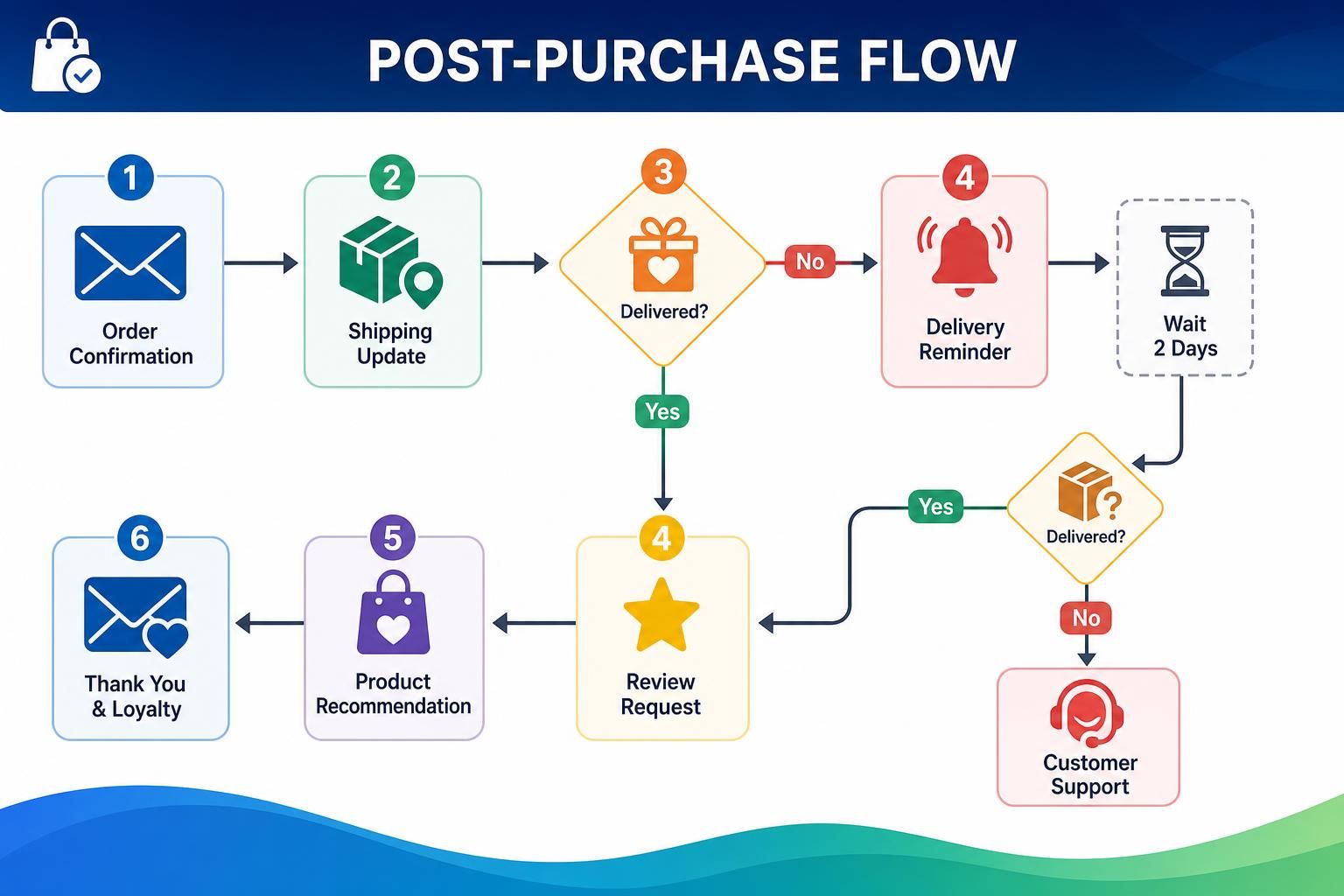
A post-purchase flow starts after someone completes an order. Its job isn’t just to say “thanks.” It reduces buyer anxiety, helps the customer use the product, and sets up the next purchase without rushing it.
Think of it like the store associate who says, “Good choice, here’s what happens next.”
- Trigger: Order placed.
- Audience exclusions: Don’t send product tips for items they didn’t buy. Suppress customers with cancelled or refunded orders where possible.
- Email count: Start with 3–4 emails.
- Timing: Email 1 immediately, Email 2 after delivery or a few days later, Email 3 after 7–14 days, Email 4 after 21–45 days.
- Message angle: Confirm the order, explain product use, request a review, recommend complementary products.
- Primary metric: Repeat purchase rate, review submissions, and click rate.
Keep cross-sells relevant. A coffee grinder buyer might need filters, not another grinder tomorrow.
Win-back Flow
A win-back flow re-engages a past customer before they disappear from your list. Trigger it when someone hasn’t purchased or clicked for a set period, such as 60, 90, or 180 days. The right window depends on your product. Skincare might use 60–90 days. Furniture might need longer.
- Trigger: No purchase or email click within your chosen inactive period.
- Audience exclusions: Remove recent buyers, active subscribers, people already in cart or checkout flows, and unsubscribed contacts.
- Email count: Start with 2–3 emails.
- Timing: Email 1 at the inactivity point, Email 2 after 5–7 days, Email 3 after another 7–14 days.
- Message angle: New arrivals, replenishment reminders, loyalty points, product improvements, or a small incentive if needed.
- Primary metric: Reactivated purchases, click rate, unsubscribe rate, and spam complaints.
Give customers a clear reason to return.
What to Track in Each Flow

Track each flow like a small sales assistant: did it move customers closer to a purchase?
Treat open rate as directional; privacy changes can inflate or obscure opens. Prioritize clicks, revenue, conversions, placed-order rate, unsubscribe rate, and spam complaints.
| Flow | Primary tracking focus | |—|—| | Welcome | First-purchase conversion rate | | Abandoned cart | Cart recovery conversion rate | | Browse abandonment | Click-to-product rate and purchase conversion rate | | Post-purchase | Repeat purchase rate, review submissions, and click rate | | Win-back | Reactivated purchases, click rate, unsubscribe rate, and spam complaints |
Launch the flows in the order closest to revenue first. You don’t need a perfect lifecycle map on day one.
- Start with abandoned cart. Set 2–3 emails for shoppers who added products but didn’t buy. Exclude anyone who completes checkout.
- Add the welcome flow. Send 2–3 emails after signup. Introduce the brand, highlight bestsellers, and explain the first-purchase offer if you use one.
- Turn on post-purchase. Reassure the customer, teach them how to use the product, then ask for a review or suggest a relevant next item.
- Add browse-abandonment. Keep it lighter than cart recovery because intent is weaker.
- Finish with win-back. Target customers who haven’t bought or engaged after a set period.
Before going live, check that people can’t receive conflicting emails on the same day, and document each trigger, delay, exclusion, and owner before adding more flows.
FAQ
What’s the Difference Between an Email Flow and a Campaign?
A campaign is a one-time email you choose to send, like a Black Friday sale. A flow is automatic. It sends when a shopper does something specific, such as signing up, abandoning a cart, buying, or going inactive.
Which Ecommerce Email Flow Should I Build First?
Start with the abandoned cart flow if your store already gets traffic and add-to-cart activity. It’s closest to the sale. If you’re still building your list, start with the welcome flow so new subscribers get a clear reason to make their first purchase.
How Many Emails Should Each Flow Include?
As a beginner, use two to four emails per flow as a typical starting point. Keep shorter flows for weaker intent, like browse-abandonment. Use slightly longer flows for welcome, post-purchase, and win-back sequences where you have more to explain or test.
Can I Build These Flows in Tools Like Klaviyo or Mailchimp?
Yes. Klaviyo, Mailchimp, and most ecommerce email platforms let you build flows using triggers, delays, filters, and email templates. The tool matters less than the logic: send the right message based on the shopper’s behavior and exclude people who no longer qualify.
Conclusion
The best ecommerce email marketing flows match a shopper’s stage in the buying journey. Welcome emails guide new subscribers. Abandoned cart and browse-abandonment emails recover missed intent. Post-purchase emails support the customer after the sale. Win-back emails try to bring past buyers back before they disappear.
Don’t try to build a giant automation system on day one. Start with the flow closest to revenue, check the trigger, timing, message, exclusions, and primary metric, then move to the next one. If you want help setting this up cleanly, use an Email Marketing service to map, build, and test your core flows before you scale.